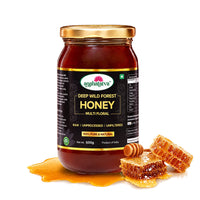
Most honey on supermarket shelves comes from managed bee boxes placed near farms. Wild forest honey is different. It is collected from wild hives deep inside forests, where bees feed on whatever trees and wildflowers happen to be in bloom. The result is a honey whose colour, aroma and taste change with the season and the forest.
At Anahatatva, our Deep Wild Forest Honey comes from the forests of Central India and is collected by local Adivasi communities who live there.
What is wild forest honey?
Wild forest honey is multiflora honey. It does not come from one crop, such as mustard or litchi, but from many different forest flowers. Because the hives are far inside the forest, the bees forage mostly on wild plants rather than on sprayed farmland.
How our honey is collected
- Who collects it: local Adivasi communities in Central India's forests, who have harvested forest honey for generations.
- Where: wild hives deep inside the forest, away from nearby farms. Honey bees can fly 2 to 3 miles from their hive for food, so distance from farmland matters.
- How it is handled: the honey is raw and unfiltered. It is not heated for processing, and nothing is added. Because it is unfiltered, you may sometimes notice tiny natural specks of wax or pollen.
- Packing: food-grade glass jars in 250 g, 500 g and 1 kg sizes.
What does it taste like?
Wild forest honey usually tastes deeper and more complex than mild, single-flower honey. You may notice floral, woody or slightly tangy notes, and the colour can range from amber to dark brown. Small differences between batches are normal, because they reflect what was flowering in the forest that season.
Why does raw honey crystallise?
Honey is a concentrated mix of natural sugars, mainly fructose and glucose. Over time, the glucose can separate out and form small crystals, so the honey turns cloudy or thick. This is a natural physical change, not a sign that the honey has spoiled (National Honey Board).
To make it liquid again: stand the closed glass jar in a bowl of warm (not boiling) water for 10 to 15 minutes and stir. Do not microwave it.
Simple ways to use wild forest honey
- Morning warm water: stir 1 teaspoon into a glass of lukewarm water with lemon. Add the honey once the water has cooled to warm, not while it is hot.
- With herbal tea or kadha: let the tea cool slightly before stirring in the honey.
- On breakfast: drizzle over toast, chilla, dosa, oats or curd with fruit.
- Instead of refined sugar: use it to sweeten smoothies, dressings and homemade desserts.
- With Ashwagandha milk: add to warm milk with Organic Ashwagandha Root Powder.
- In a moringa drink: a little honey softens the earthy taste of moringa. See How to Use Moringa Powder Daily.
Honey and sore throats: what the evidence says
Honey is a traditional home remedy for coughs and sore throats. A Cochrane review of six small trials in children aged 1 to 18 years found that honey probably eases cough symptoms better than no treatment or a placebo, mostly over one to three days. The evidence was rated low to moderate quality (Cochrane). Honey is a food, not a medicine. See a doctor if a cough lasts longer than a few days or comes with fever or breathing difficulty.
Important: no honey for babies under 1 year
Do not give honey of any kind, raw or processed, to children under 12 months. Honey can contain spores that cause infant botulism, a rare but serious illness, and cooking does not reliably destroy them (Cleveland Clinic).
People with diabetes should remember that honey is still a sugar, and should talk to their doctor about how much is right for them.
How to store honey
- Store the jar tightly closed in a cool, dry place, away from direct sunlight.
- Do not refrigerate it, because cold speeds up crystallisation.
- Always use a clean, dry spoon, because moisture can spoil the honey.
Frequently asked questions
Is wild forest honey the same as multiflora honey?
Wild forest honey is a type of multiflora honey: bees make it from many different flowers. What makes it "wild forest" honey is that it comes from wild hives inside the forest rather than from managed bee boxes.
Is Anahatatva honey filtered?
No. Our Deep Wild Forest Honey is raw and unfiltered, with nothing added.
Why does my jar look different from my last one?
Colour and taste change with the season and the flowers in bloom. This is normal for natural forest honey.
Is crystallised honey bad?
No. Crystallisation is natural. Warm the jar gently in water to make it liquid again.
Can I cook with raw honey?
You can, but adding it at the end to warm (not hot) food or drinks keeps more of its natural flavour and aroma.
Which sizes are available?
250 g, 500 g and 1 kg glass jars. Shop Deep Wild Forest Honey.
Taste the forest. Shop Anahatatva Deep Wild Forest Honey, with free shipping across India.